Bulking vs. Cutting: How to Use TDEE for Body Recomposition
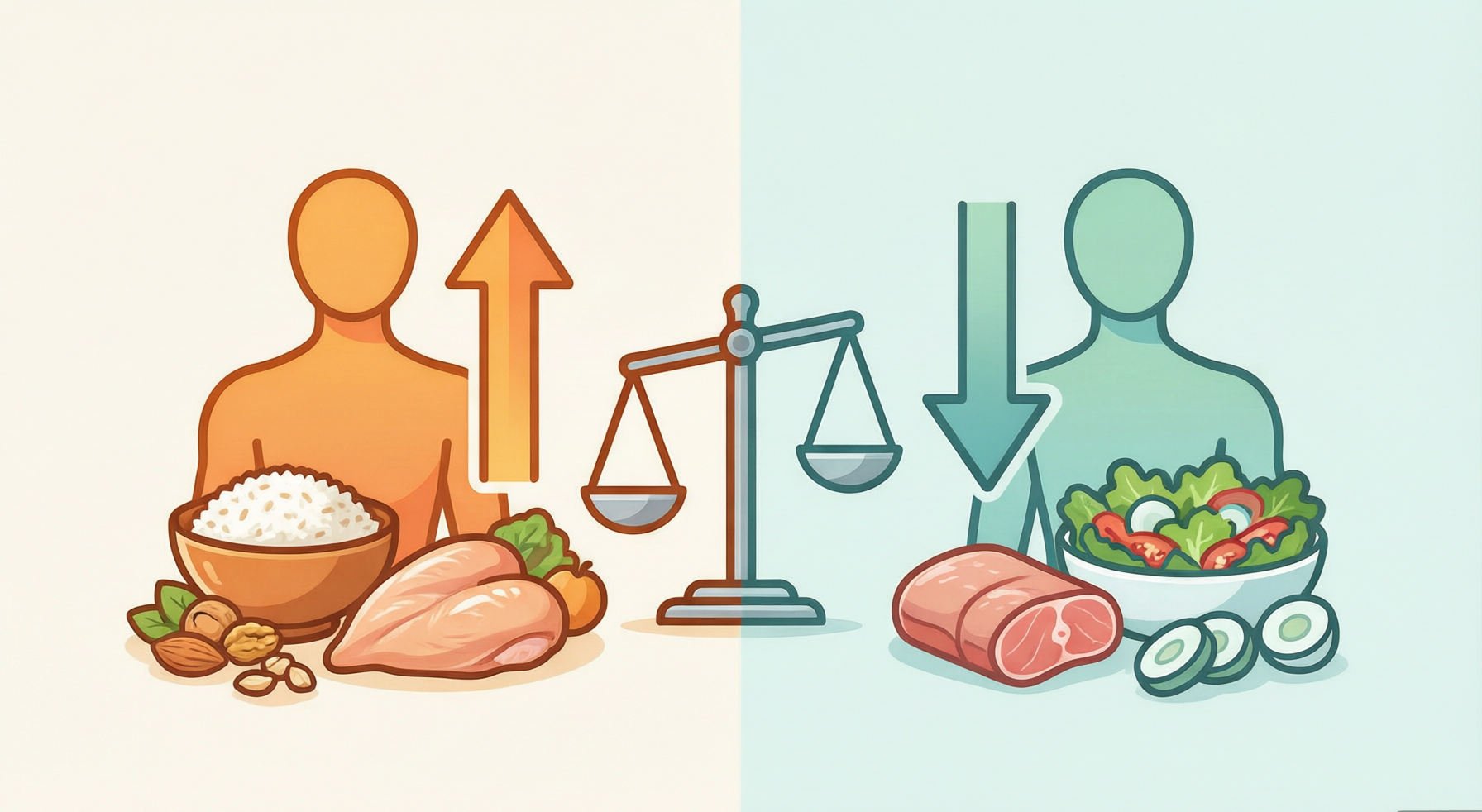
Whether your goal is to build muscle, lose fat, or do both in sequence, your Total Daily Energy Expenditure (TDEE) is the foundational number that determines success. Bulking and cutting are simply strategic manipulations of calories relative to your TDEE: eat above it to gain, eat below it to lose. But the details matter enormously. Too large a surplus and you gain unnecessary fat; too aggressive a deficit and you lose muscle and trigger metabolic adaptation.
This guide covers the science and practice of using TDEE for both bulking and cutting phases, including how to size your surplus or deficit, when to use mini-cuts, and how to transition between phases effectively.
Understanding the Energy Balance Framework
At its core, body composition change follows the laws of thermodynamics:
- Caloric surplus (intake > TDEE): The body stores the excess energy, primarily as fat but also as muscle if resistance training stimulus is present.
- Caloric deficit (intake < TDEE): The body draws on stored energy (fat and potentially muscle) to make up the shortfall.
- Caloric maintenance (intake = TDEE): Body weight remains stable, though body composition can still change under specific conditions (body recomposition).
The key insight is that TDEE is your reference point, not your BMR. As explained in our TDEE vs. BMR article, TDEE includes all four components of energy expenditure (BMR, TEF, EAT, and NEAT), while BMR only covers resting metabolism. All surplus and deficit calculations should be based on TDEE.
Bulking: Eating Above Your TDEE
What Is a Bulking Phase?
A bulk is a period of intentional caloric surplus designed to maximize muscle gain. Muscle protein synthesis is an energy-expensive process, and research consistently shows that a caloric surplus facilitates greater muscle growth compared to eating at maintenance, particularly for intermediate and advanced trainees.
There are two main approaches to bulking:
Lean Bulk vs. Dirty Bulk
| Characteristic | Lean Bulk | Dirty Bulk |
|---|---|---|
| Caloric surplus | +200-350 kcal above TDEE | +500-1,000+ kcal above TDEE |
| Expected muscle gain/month | 0.5-1 lb (intermediate) | 0.5-1 lb (same as lean bulk) |
| Expected fat gain/month | 0.5-1 lb | 2-4+ lbs |
| Food quality emphasis | High (whole foods, adequate protein) | Low (anything to hit calories) |
| Duration | 3-6+ months | Typically shorter (cuts needed sooner) |
| Long-term effectiveness | Superior (less fat to lose later) | Inferior (excess fat gain requires longer cuts) |
A 2012 study by Garthe et al. published in the International Journal of Sport Nutrition and Exercise Metabolism compared two groups of athletes: one in a lean bulk (+200-300 kcal surplus) and one in a more aggressive bulk (+600+ kcal surplus). The lean bulk group gained comparable amounts of muscle while gaining significantly less fat, supporting the superiority of moderate surpluses.
Recommended Surplus
Beginners: +300-500 kcal above TDEE (you can build muscle and lose fat simultaneously as a novice, so a larger surplus is tolerable).
Intermediate lifters: +200-350 kcal above TDEE.
Advanced lifters: +150-250 kcal above TDEE (muscle gain potential is smaller, so excess calories are more likely stored as fat).
Setting Your Bulk Calories: A Step-by-Step Approach
- Calculate your TDEE. Use our TDEE Calculator to get your starting estimate. If you know your body fat percentage, use the Katch-McArdle option for better accuracy (see our BMR formula comparison).
- Add your surplus. For a lean bulk, add 200-350 calories to your TDEE. For example, if your TDEE is 2,600 kcal, your bulk target is 2,800-2,950 kcal.
- Set protein intake. Aim for 0.8-1.0 grams of protein per pound of body weight (1.8-2.2 g/kg). This ensures adequate amino acids for muscle protein synthesis.
- Distribute remaining calories. Split the rest between carbohydrates (for training performance) and fats (for hormonal health). A common split is 45-55% carbs, 25-30% fat.
- Track and adjust. Weigh yourself weekly. Aim for a gain of 0.25-0.5% of body weight per week. If you are gaining faster, reduce calories slightly. If weight is stalling, increase by 100-150 kcal.
Common Bulking Mistakes
- "Eating everything in sight": A dirty bulk might feel productive, but excess fat gain requires a longer, harder cut later. Research by Slater et al. (2019) in Nutrients found that experienced lifters on a lean bulk gained similar muscle to those on an aggressive bulk but with 50% less fat gain.
- Not tracking food: Without weighing and logging food, most people significantly overestimate their intake during a bulk and end up in a much larger surplus than intended.
- Ignoring TDEE drift: As you gain weight during a bulk, your TDEE increases. Recalculate every 10-15 lbs of body weight gained. See our accuracy guide for validation methods.
- Staying in a bulk too long: Prolonged surpluses lead to increasing fat gain and decreasing insulin sensitivity. Most people benefit from bulking for 3-6 months before initiating a cut.
Cutting: Eating Below Your TDEE
What Is a Cutting Phase?
A cut is a period of intentional caloric deficit designed to maximize fat loss while preserving muscle mass. The challenge is creating a deficit large enough to produce meaningful fat loss but small enough to minimize muscle catabolism and metabolic adaptation.
Sizing Your Deficit
| Deficit Size | Calories Below TDEE | Expected Weight Loss/Week | Best For |
|---|---|---|---|
| Conservative | -200 to -300 kcal | 0.25-0.5 lbs | Muscular individuals, those close to goal body fat |
| Moderate (recommended) | -300 to -500 kcal | 0.5-1.0 lbs | Most people; best balance of fat loss and muscle preservation |
| Aggressive | -500 to -700 kcal | 1.0-1.5 lbs | Short-term use (4-8 weeks), higher body fat individuals |
| Very aggressive (crash diet) | -700+ kcal | 1.5+ lbs | Not recommended; high risk of muscle loss and metabolic slowdown |
Research by Garthe et al. (2011) in the Scandinavian Journal of Medicine & Science in Sports compared slow weight loss (0.7% body weight per week) to fast weight loss (1.4% per week) in athletes. The slow loss group actually gained lean mass while losing fat, whereas the fast loss group lost lean mass. This supports moderate deficits over aggressive ones for anyone who cares about body composition.
The Golden Rule of Cutting
Your deficit should be proportional to your body fat percentage. Leaner individuals need smaller deficits to preserve muscle. Those with higher body fat can tolerate larger deficits because they have more energy reserves. As a general guideline: if you are above 20% body fat (men) or 30% (women), a -500 to -700 deficit is reasonable. If you are below 15% (men) or 25% (women), stick to -200 to -400.
Preserving Muscle During a Cut
Caloric deficits create a catabolic environment, and the body will break down both fat and muscle for energy. To shift the balance toward fat loss and muscle preservation:
- Keep protein high: 1.0-1.2 grams per pound of body weight (2.2-2.6 g/kg). Research by Helms et al. (2014) in the Journal of the International Society of Sports Nutrition found that protein intakes of 2.3-3.1 g/kg of fat-free mass minimized lean mass loss during caloric restriction in trained individuals.
- Continue resistance training: Do not switch to "high reps for toning." Maintain your training intensity (weight on the bar) to signal to your body that muscle tissue is still needed.
- Avoid excessive cardio: While cardio increases your deficit, too much can interfere with recovery and increase muscle catabolism. Use it as a supplement to the dietary deficit, not the primary tool.
- Prioritize sleep: Sleep deprivation during a caloric deficit amplifies muscle loss. A study by Nedeltcheva et al. (2010) in the Annals of Internal Medicine found that sleep-restricted individuals on a deficit lost 60% more muscle than those sleeping 8.5 hours.
Mini-Cuts: The Bridge Between Phases
A mini-cut is a brief, intentionally aggressive dieting phase lasting 2-4 weeks at a deficit of 700-1,000 calories below TDEE. The goal is to shed excess fat accumulated during a bulk without losing significant muscle, then return to the bulk.
When to Use a Mini-Cut
- Your body fat has increased 3-5% above your starting point for the bulk
- You are approaching a body fat level where insulin sensitivity starts to decline (approximately 15-18% for men, 25-28% for women)
- You feel sluggish, your training performance is declining, and you suspect excess fat gain is impairing your results
- You want to "reset" before continuing a longer bulk
Mini-Cut Protocol
- Calculate your current TDEE (recalculate since your weight has increased during the bulk).
- Set intake at TDEE minus 700-1,000 kcal. Keep protein at 1.0-1.2 g/lb.
- Run the mini-cut for 2-4 weeks maximum. Do not extend it further.
- Monitor body weight daily and take weekly progress photos.
- When you reach your target body fat (or close to it), transition back to a lean bulk by increasing calories to TDEE + 200-350.
Mini-Cut vs. Full Cut
A mini-cut is not a replacement for a proper cutting phase. If your body fat is significantly above your goal (more than 5% above), commit to a full cut at a moderate deficit (-300 to -500 kcal) for 8-16 weeks rather than repeatedly doing mini-cuts. Mini-cuts are maintenance tools for staying lean during extended bulks, not primary fat loss strategies.
Transitioning Between Bulk and Cut
How you move between phases affects both your results and your metabolic health.
Bulk to Cut Transition
- Do not jump directly from surplus to aggressive deficit. Instead, reduce calories gradually over 1-2 weeks. Drop from your bulk target to maintenance (TDEE) for one week, then begin the deficit.
- Recalculate your TDEE at your new body weight. Since you likely gained weight during the bulk, your TDEE will be higher than when you started.
- Set your cut target at 300-500 kcal below your new TDEE.
Cut to Bulk Transition
- Do not immediately jump into a surplus. After a cut, your metabolism may be slightly suppressed due to metabolic adaptation. Spend 1-2 weeks at maintenance to allow metabolic rate to stabilize.
- Consider reverse dieting if your cut was prolonged (12+ weeks). Increase calories by 50-100 per week until you reach your bulk target. This helps minimize fat rebound.
- Start the bulk conservatively at TDEE + 200 and increase after one week if weight gain is insufficient.
How Long Should Bulks and Cuts Last?
| Phase | Typical Duration | When to End |
|---|---|---|
| Lean Bulk | 3-6 months | When body fat reaches 15-18% (men) or 25-28% (women), or when rate of gain exceeds 0.5% body weight per week |
| Cut | 8-16 weeks | When you reach goal body fat, or when performance drops significantly and diet fatigue is high |
| Mini-Cut | 2-4 weeks | When excess fat from bulk is shed, or when diet fatigue becomes significant |
| Maintenance (transition) | 1-3 weeks | When weight stabilizes and appetite normalizes |
Practical Example: Full Year of Phased Training
Here is how a hypothetical intermediate lifter might structure their year:
- January-March (Cut): Starting at 190 lbs, TDEE = 2,700. Eating 2,200-2,400 kcal/day. Goal: reach 180 lbs at 12% body fat.
- April (Maintenance): Eating at TDEE (~2,600 kcal at new body weight). Allowing metabolism to stabilize.
- May-September (Lean Bulk): Eating at TDEE + 250 = ~2,850 kcal. Gaining approximately 0.5 lb per week. Target: reach 192-195 lbs.
- October (Mini-Cut): Body fat has crept up to 14%. Cutting at TDEE - 800 for 3 weeks to return to 12-13% body fat.
- November-December (Lean Bulk cont.): Return to surplus. End the year at approximately 196 lbs, leaner and more muscular than the start.
Related Resources
- TDEE Calculator — Calculate your starting numbers for any phase
- TDEE vs. BMR — Understand why you should base targets on TDEE, not BMR
- Metabolic Adaptation — What happens during prolonged deficits
- How Accurate Is TDEE? — Validate your calorie targets empirically
- Common Tracking Mistakes — Avoid errors that sabotage your phase results
Frequently Asked Questions
For a lean bulk, add 200-350 calories above your TDEE. Beginners can tolerate up to 500 calories above TDEE due to higher muscle-building potential. Advanced lifters should stay closer to 150-250 above TDEE. The goal is to gain 0.25-0.5% of body weight per week; faster gain means excess fat accumulation.
For a sustainable cut, aim for 300-500 calories below your TDEE. This typically produces 0.5-1 lb of fat loss per week. More aggressive cuts of 500-700 calories below TDEE can work for short periods (4-8 weeks) but increase the risk of muscle loss and metabolic adaptation. Never eat below your BMR for extended periods.
A mini-cut is a brief (2-4 week) aggressive dieting phase at 700-1,000 calories below TDEE. Use it during a lean bulk when body fat has increased 3-5% above your starting point, or when you approach 15-18% body fat (men) / 25-28% (women). Mini-cuts help maintain insulin sensitivity and keep bulks lean, but they are not a replacement for full cutting phases.
Body recomposition (building muscle while losing fat) is possible but limited to specific populations: beginners, those returning from a layoff, individuals with high body fat, and those using performance-enhancing substances. For most trained individuals, dedicated bulk and cut phases are more effective. Eat at a modest surplus (200-350 above TDEE) for the bulk and a moderate deficit (300-500 below TDEE) for the cut.
Do not jump directly from surplus to aggressive deficit. First, recalculate your TDEE at your new body weight (it will be higher than when you started the bulk). Then reduce calories gradually: spend one week at maintenance (your new TDEE), then begin a 300-500 calorie deficit. This gradual transition helps normalize hunger hormones and reduces the psychological shock of switching from eating more to eating less.