Body Fat Calculator
Estimate your body fat percentage using the U.S. Navy circumference method or the BMI-based formula, with ACE category classification.
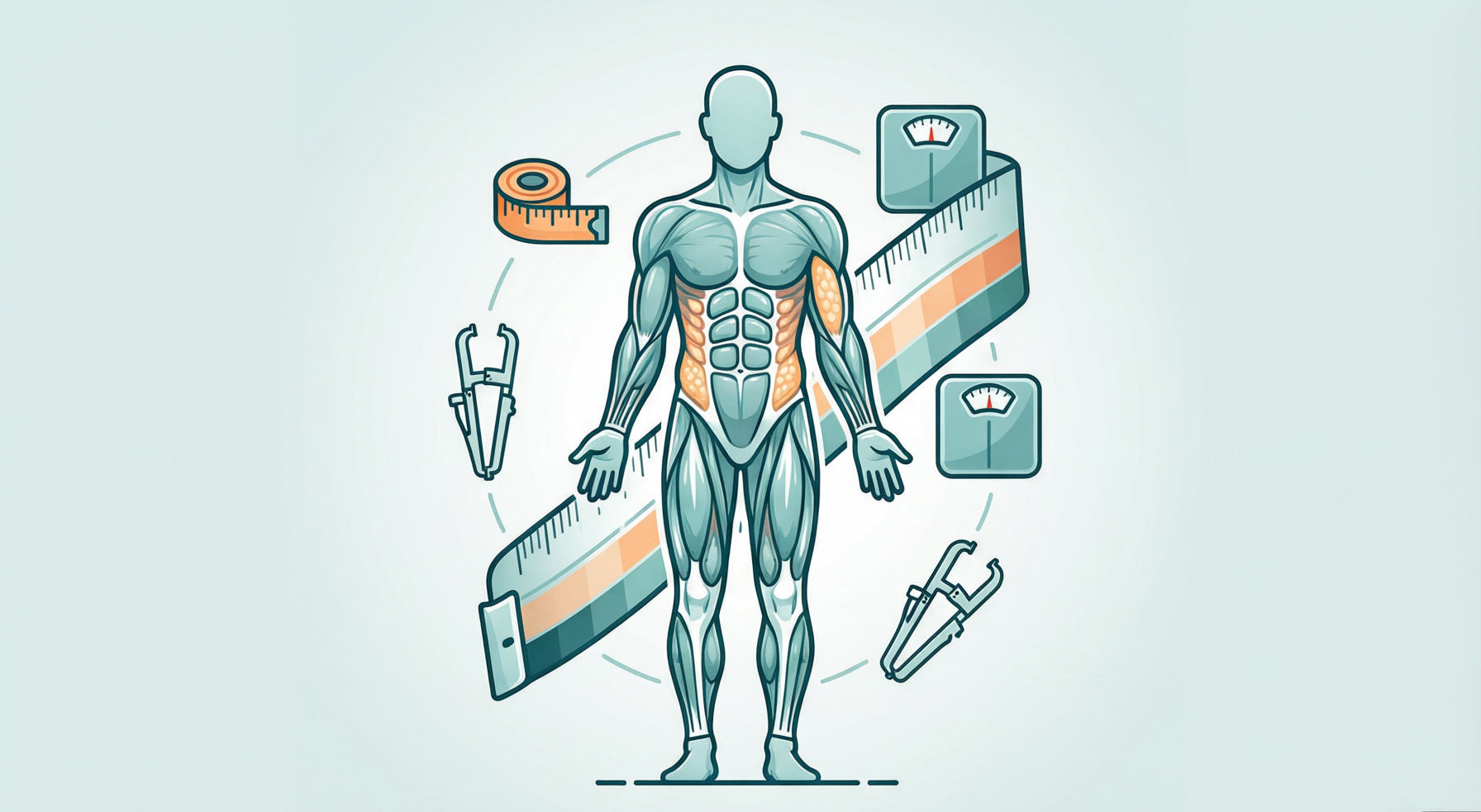
Estimate your body fat percentage using the U.S. Navy circumference method or the BMI-based formula, with ACE category classification.
Body fat percentage represents the proportion of your total body weight that is composed of adipose (fat) tissue. Unlike BMI, which only considers total weight relative to height, body fat percentage directly measures what matters most for health and aesthetics: the ratio of fat mass to lean mass.
There are two types of body fat: subcutaneous fat (stored under the skin) and visceral fat (stored around internal organs). Visceral fat is more metabolically active and strongly linked to cardiovascular disease, type 2 diabetes, and inflammation. Two people with identical body fat percentages can have very different health profiles based on where that fat is distributed.
The U.S. Navy body fat formula was developed by Hodgdon and Beckett (1984) at the Naval Health Research Center in San Diego. It uses circumference measurements to estimate body density, which is then converted to body fat percentage using the Siri equation (body fat % = (495 / body density) - 450).
Men: Body Fat % = 86.010 x log10(waist - neck) - 70.041 x log10(height) + 36.76
Women: Body Fat % = 163.205 x log10(waist + hip - neck) - 97.684 x log10(height) - 78.387
These published constants are defined for measurements in inches (Hodgdon & Beckett, 1984). The calculator converts centimetre inputs to inches before applying the equation, so both unit modes use the same formula.
The Navy method has been validated against hydrostatic weighing and shows a correlation of approximately r = 0.7-0.8 with DEXA scans. Its standard error of estimate is approximately 3-4% body fat, making it suitable for tracking trends over time but less precise than clinical methods.
Accurate measurements are critical for reliable results. Follow these guidelines:
For consistency, measure at the same time of day (morning, fasted, before exercise), use the same tape measure, and take 2-3 measurements at each site to average.
The American Council on Exercise (ACE) provides the following body fat classification standards, which are widely used in fitness and health assessment:
| Category | Men | Women | Description |
|---|---|---|---|
| Essential Fat | 2-5% | 10-13% | Minimum for survival; hormonal dysfunction below this |
| Athletes | 6-13% | 14-20% | Typical of competitive athletes in lean sports |
| Fitness | 14-17% | 21-24% | Lean, athletic appearance; generally considered ideal |
| Average | 18-24% | 25-31% | Typical for healthy non-athletic adults |
| Above Average | 25%+ | 32%+ | Increased health risk; consider lifestyle changes |
| Obese | 25%+ | 32%+ | Significantly elevated health risks |
Source: American Council on Exercise (ACE). Note that "essential fat" ranges differ between sexes because women require additional fat for reproductive function and hormonal balance.
Several methods exist for measuring or estimating body fat, each with different trade-offs between accuracy, cost, and accessibility:
| Method | Accuracy (Error) | Cost | Accessibility | Best For |
|---|---|---|---|---|
| DEXA Scan | 1-2% | $50-150/session | Clinical/Research | Gold standard; full body composition |
| Hydrostatic Weighing | 2% | $50-100/session | University/Lab | Highly accurate; requires submersion |
| Bod Pod (ADP) | 2-3% | $50-100/session | Fitness centers | Accurate; non-invasive |
| Skinfold Calipers | 3-4% | $5-50 (calipers) | Gym/Trainer | Affordable; good for tracking trends |
| US Navy (Tape) | 3-4% | Free (tape measure) | Anywhere | Convenient; reasonable accuracy |
| BIA Scale | 4-8% | $30-300 | Home/Gym | Convenient; inconsistent accuracy |
| BMI Formula | 4-5% | Free | Anywhere | Rough estimate when no tools available |
The US Navy method is a practical, free tool for tracking body fat trends over time. For the most accurate single measurement, use DEXA. For consistent tracking, measure circumference at the same time each week and use this calculator. Remember that body fat percentage is more meaningful than total weight for assessing body composition progress.
The US Navy circumference method has a correlation of approximately r=0.7-0.8 with DEXA scans (the gold standard), with a standard error of about 3-4% body fat. It is more accurate for men than women due to different fat distribution patterns. The method was developed by Hodgdon and Beckett (1984) at the Naval Health Research Center. For the most accurate results, measure at the same time of day (morning is best), use a flexible tape measure, and take 2-3 measurements at each site to average.
According to the American Council on Exercise (ACE), healthy body fat ranges are: For men - Essential fat: 2-5%, Athletes: 6-13%, Fitness: 14-17%, Average: 18-24%, Above Average: 25%+. For women - Essential fat: 10-13%, Athletes: 14-20%, Fitness: 21-24%, Average: 25-31%, Above Average: 32%+. Women naturally carry more body fat due to reproductive requirements. Body fat below essential levels is dangerous and can cause hormonal dysfunction.
For men: measure neck circumference at the narrowest point below the Adam's apple, and waist circumference at the navel. For women: measure neck as for men, waist at the narrowest point (natural waistline), and hips at the widest point. Use a flexible tape measure, keep it snug but not compressing the skin, and take measurements on bare skin. Measure in the morning before eating for consistency.
DEXA (Dual-Energy X-ray Absorptiometry) is the gold standard for body composition analysis, providing precise measurements of fat mass, lean mass, and bone density with approximately 1-2% error. Hydrostatic (underwater) weighing is also highly accurate (~2% error). Bod Pod (air displacement plethysmography) offers similar accuracy to hydrostatic weighing. Skinfold calipers (3-7 site measurements) can be accurate (3-4% error) when performed by an experienced technician. Bioelectrical impedance (BIA) scales are convenient but less accurate, with errors of 4-8%.
Gym and home body fat scales use bioelectrical impedance analysis (BIA), which sends a small electrical current through the body and estimates body fat based on the resistance encountered. BIA accuracy is heavily influenced by hydration status, recent food intake, exercise, skin temperature, and even the time of day. Studies show BIA can vary by 4-8% compared to DEXA depending on conditions. For tracking trends, use the same scale at the same time of day under consistent conditions, or use circumference measurements with the Navy formula.